How Airbnb put text generation to work in customer support
A week before ChatGPT arrived, Airbnb described how it had rebuilt parts of its customer support around generative text models, learning from years of its own agents' conversations. Today its AI assistant resolves nearly half of the issues it starts. Here is the path, and what it means for support teams that live on WhatsApp.
Airbnb's support team answers guests and hosts in dozens of languages, about refunds, cancellations, payments and listings that are not what they seemed. On 23 November 2022, a week before ChatGPT launched, three of its engineers described how text generation models were reshaping that work. The models were small by today's standards. The ideas were not, and they still describe the most reliable way we know to bring AI into a support team.
The problem: years of answers, locked in conversations
Support teams sit on a treasure they rarely use. In the authors' words, "we have accumulated massive amounts of records of our human agents offering help to our guests and hosts at Airbnb". Each conversation shows what a customer asked and how a good agent answered. Older models could not use that knowledge well: each task needed its own classifier, trained for one narrow job. The team's bet was that "generative models can now obtain some domain knowledge through large-scale pre-training and then produce high-quality text", and that one way of framing problems could serve many tasks at once.
How they built it
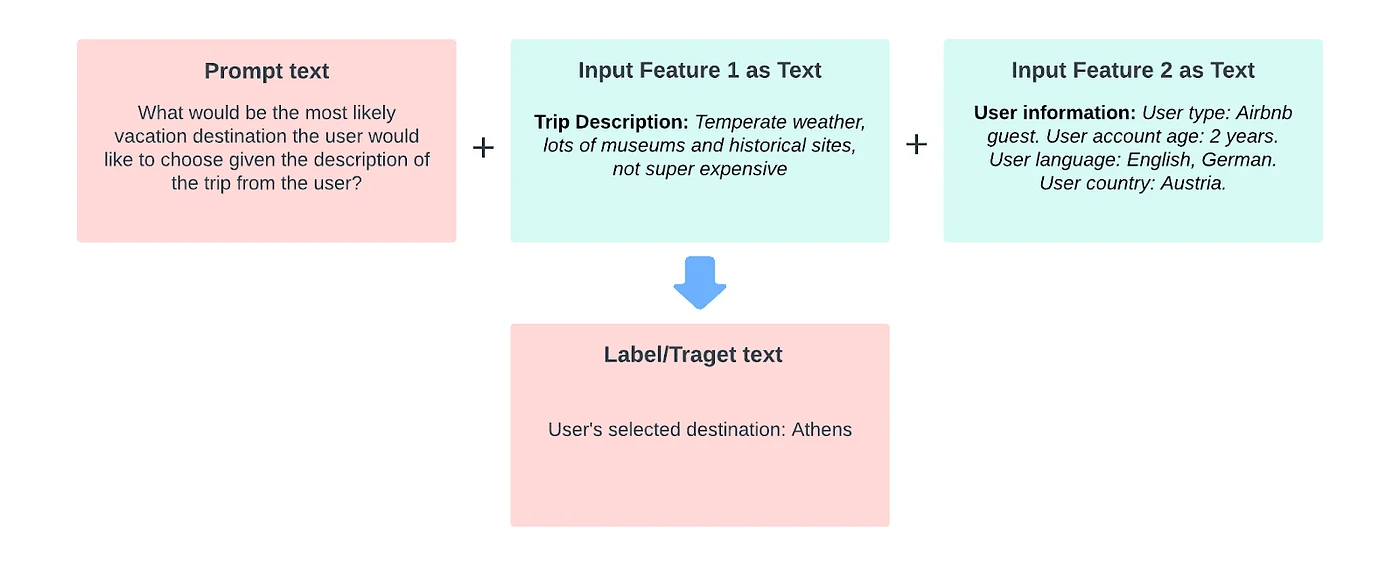
One framing for every task. Every problem became text in, text out. "A prompt is a short piece of textual instruction that informs the model of the task at hand," the authors write. The prompt, the inputs and even the expected answer are all written as text, as the figure at the top of this article shows.
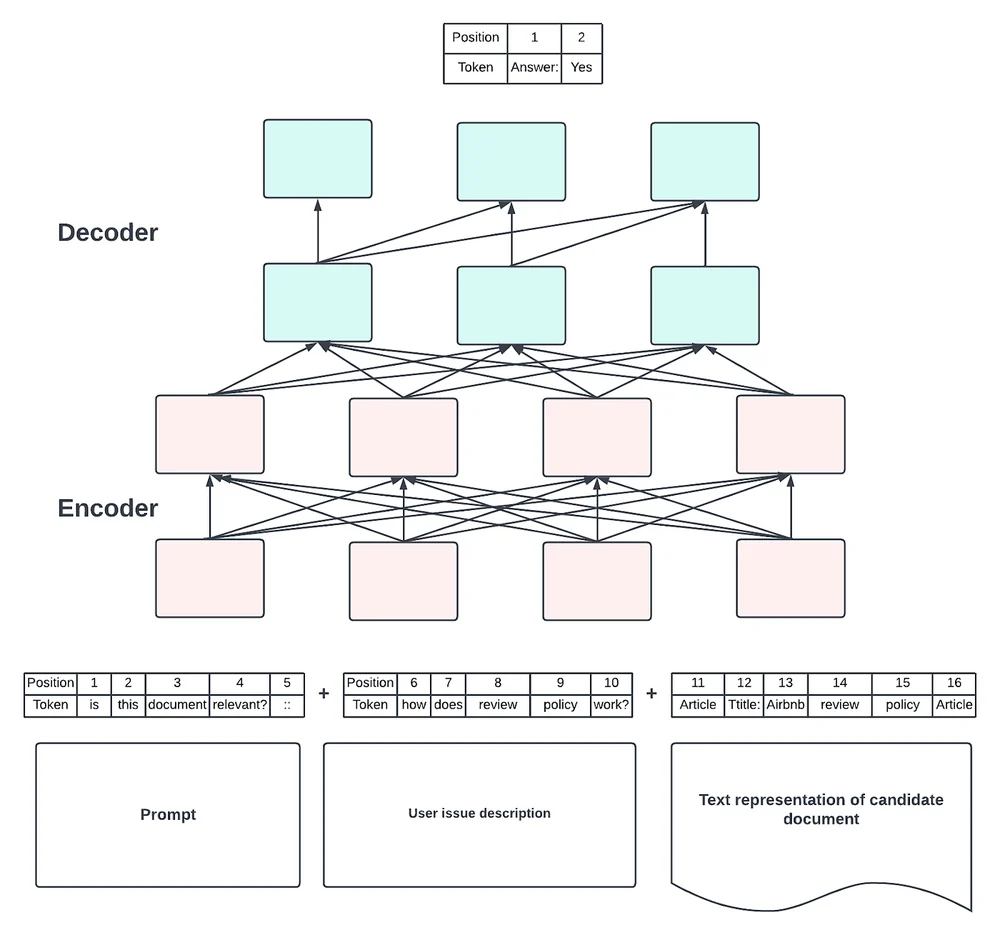
Help articles, ranked by asking a question. For Help Center search and the help chatbot, Airbnb used to score each candidate article with an encoder and a classification head. The new model, a fine-tuned MT5, reads the user's issue and an article's title, summary and keywords, and simply answers "Yes" or "No" to whether the article helps. Adding the user's reservation details as plain text personalized the ranking. On Airbnb's offline test, the ranking score (NDCG) rose from 0.811 for the old model to 0.862 for the new one with personalization.
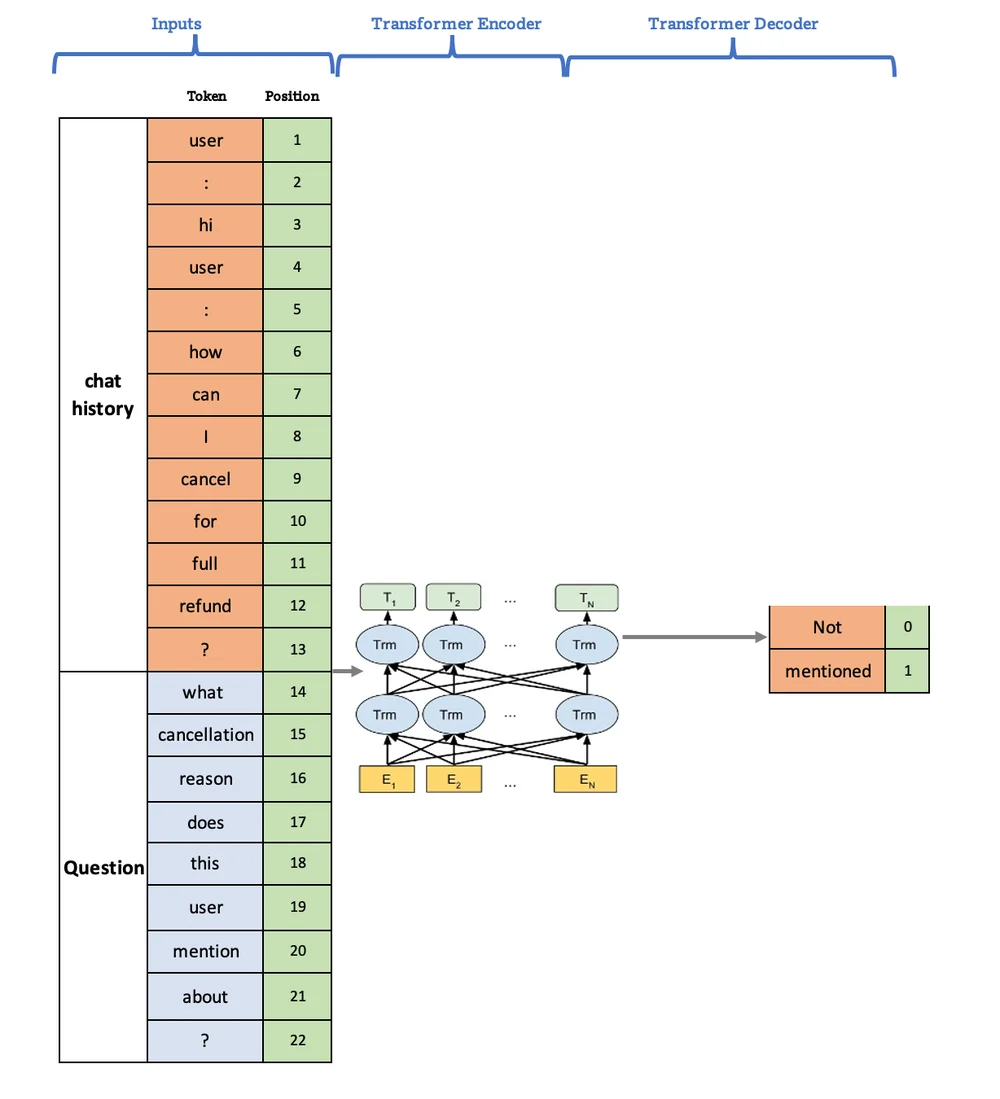
A copilot for human agents. While an agent chats with a customer, an assistant suggests the right reply template. To choose one, a single question-answering model reads the whole conversation and answers questions about it: is this about a cancellation, does the host or the guest want to cancel, and why? Airbnb trained it on two kinds of data, carefully annotated examples and its large but noisier logs, and "found that combining these two datasets together yielded the best performance". It reports 89.98 percent accuracy when the model answers every question, and 95.85 percent when it answers only the half it is most confident about. That trade between coverage and accuracy is the lever every support team should know.
A chatbot that repeats your problem first. Customers trust a bot more when it shows it has understood. Airbnb's chatbot now restates the issue before helping, and the training labels came free: replies in which human agents began with "I understand that you". As the authors put it, "this simple heuristic gives us millions of training labels for free". Among the models tested, T5 won. Its first outputs were bland, because one generic sentence, "I understand that you have concerns about a reservation", appeared 7,297 times in the data. Filters and reranking did not fix it. Clustering the training targets and removing the generic clusters did: "In the end, we found the best solution was to tune the training data."
What it delivered
Beyond the offline figures above, Airbnb reports online results without numbers: "significantly higher relevance" for Help Center search in an A/B test, a "large engagement rate improvement" for the agent assistant, and better engagement with the chatbot. The post says nothing about latency or cost, so read it as a design story more than a business case.
What has changed since
From helping agents to talking with customers. In 2025 Airbnb launched an AI assistant that customers talk to directly, starting in the United States. By November it could give "answers tailored to your reservation or listing" and handle actions such as "canceling or changing reservation dates" in the chat. Airbnb reported that it had "reduced people's need to contact a human agent by around 15%" and cut "the typical resolution time from hours to seconds". On an earnings call in August 2025, the company described it as a custom agent built on 13 different models. Airbnb has not said whether the 2022 models live on inside it. What carried over is the approach.
Scale. In August 2026 Airbnb reported that "nearly 45 percent of issues that begin with our AI assistant are now resolved without a human agent", in more than 50 languages, and that its support cost per booking fell about 16 percent year over year, "driven in part by improvements to our AI assistant". Note the wording: the 45 percent counts issues that start with the assistant, not every issue. In its fall update at the end of September, Airbnb said it is expanding support to voice.
People stayed in the loop. In October 2025 Airbnb researchers published a paper on an "agent-in-the-loop" approach in which human agents' feedback continuously improves the assistance model. It is the 2022 idea, learning from your own agents, turned into a routine.
Why it matters for your business
In Indonesia, customer service mostly happens on WhatsApp, in a mix of Indonesian, English and slang, with spikes around Harbolnas, Ramadan and the school holidays. Most teams already own Airbnb's starting point: years of chat transcripts showing how their best agents answer. Few use them.
Airbnb's order of work fits a team of any size. Help your agents before you replace any conversation. Turn every check into a question the model answers. Let the model stay quiet when it is unsure. And when the output is dull or wrong, look at the training data before blaming the model. Chat transcripts are personal data under Indonesia's PDP law, so names, phone numbers and booking codes should be masked before transcripts train a model or reach a hosted one.
How we would build it today
- Mine your transcripts. Export WhatsApp Business and CRM conversations, mask personal data, and group them by issue to find the top ten reasons people contact you.
- Start with agent assist. A language model drafts replies and fills intent fields such as refund, reschedule or complaint. Agents accept or edit, and every edit becomes training and test data.
- Answer from your own content. Retrieval over your help pages and policies, a relevance check before an answer goes out, and a rule to hand over to a person, with the context, when confidence is low.
- Then let the bot act, narrowly. The top few intents only, with real actions in your systems and a confirmation step for anything involving money.
- Measure the honest number. Resolved without a human, counted only among conversations that started with the bot, next to how often customers come back within two days and the cost per resolved conversation.
Airbnb's models have changed several times since 2022. The lesson has not: the knowledge your support team needs is already in its conversations, and the work is in turning those conversations into good training data.