How Airbnb prices millions of one-of-a-kind listings with no right answer to learn from
Airbnb cannot know the perfect price for a listing-night, because it only ever sees that night booked or empty, once. Its workaround is a lesson for anyone pricing rooms, tours, or anything with a deadline.
A hotel chain can price a room because it has hundreds of near-identical rooms and years of data on each. Airbnb has the opposite problem: every listing is one of a kind. A different location, host, view, and set of amenities. And each listing-night can only be observed once, as either booked or empty. You never get to see what would have happened at a different price for that same night. So there is no "correct price" sitting in the data to train a model against. In 2018 Airbnb's team explained, across a KDD paper on its pricing model and an engineering post on Learning Market Dynamics for Optimal Pricing, how they made this into a problem a machine can actually solve. It is one of the cleanest case studies in the hard kind of pricing, the kind with perishable inventory and a deadline.
The problem: no demand curve, no label
Classic revenue-maximizing pricing assumes you can estimate a demand curve: how likely a sale is at each price. That needs many comparable products and repeated observations. Airbnb has neither. Every listing is unique, and a given night for a given home is a single roll of the dice. If it books, maybe the price was a little low. If it sits empty, maybe it was a little high. But you can never prove it, because the alternative price was never tested on that exact night. This is the core difficulty: the thing you want to predict, the optimal price, is never observed.
How they built it
Airbnb's pricing paper describes a system in three parts:
- A booking-probability model. A gradient-boosted model that estimates the chance a given listing-night gets booked, from three kinds of signal: the listing itself (price, capacity, amenities, reviews, past occupancy), time (season, day of week, and how far ahead the date is), and live supply and demand in that market (how many similar listings are being viewed and contacted).
- A pricing strategy model. This is the clever part. Because there is no true "best price" to aim at, Airbnb does not regress toward a target price. Instead it learns a multiplier on the host's price using a deliberately lopsided objective: on nights that booked, nudge toward "you could have charged a bit more"; on nights that stayed empty, nudge toward "you should have asked for less." The penalty for guessing wrong is asymmetric on purpose, so the model learns how differently demand reacts to a price going up versus down, rather than assuming they are mirror images.
- A personalization layer that adapts the suggestion to each host's own goals, minimum and maximum prices, and special local events.
Since they could not measure accuracy against a "right price," they invented two offline yardsticks to steer and judge the model: roughly, one that checks how often the model correctly suggested a lower price on nights that ended up empty, and one that measures how much money was left on the table by suggesting too low on nights that sold. Watching those two move in the right direction is how you improve a model that has no ground truth.
Pricing against a deadline
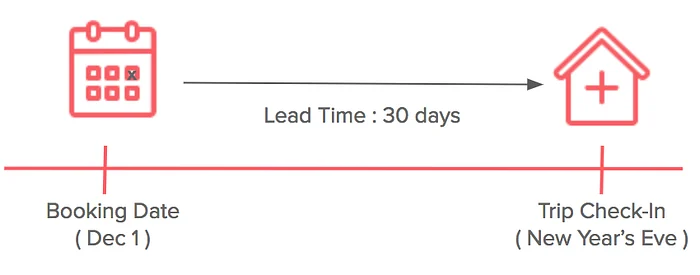
The second post tackles a subtler point: a night does not just have a demand level, it has a demand schedule. Bookings for a given date trickle in over the weeks before check-in, and that arrival pattern is what you price against as the date approaches. The gap between the day someone books and the day they check in is the lead time.
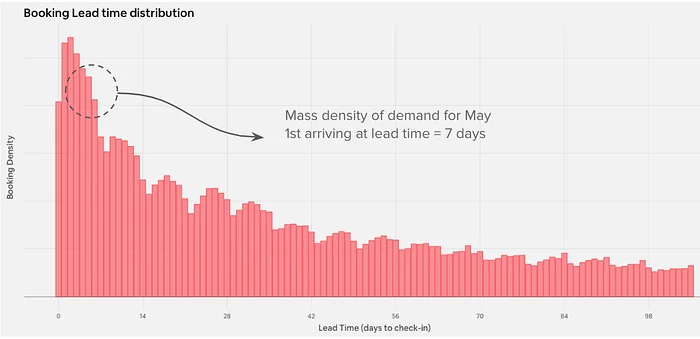
Predicting a separate number for every lead-time day, for every listing, for every date, is hopeless: too sparse, too high-dimensional. So Airbnb imposed a shape. They assumed bookings arrive like a well-known statistical process (a Poisson process, whose timing follows a Gamma distribution) and layered on the weekly weekday-weekend rhythm with a few wave terms. That collapses thousands of would-be predictions down to about five parameters per market, and a model only has to predict those five. Airbnb reported this hybrid of structure plus machine learning roughly halved the error versus a conventional model and generalized better, though they did not publish an absolute figure.
Both models feed the products hosts actually see: Price Tips and Smart Pricing. Airbnb reported that online A/B tests showed the approach worked, without putting a headline percentage on it.
What has changed since
- Publicly, the 2018 paper is still Airbnb's last deep technical description of the pricing algorithm itself. Most Airbnb pricing news since has been about fee transparency, not the model: rolling out total-price display, and in April 2025 making it the global default, at which point Airbnb said more than four in five hosts had used at least one of its pricing tools in the prior year.
- In August 2026, on its earnings call, Airbnb said it is building an "entirely new" AI pricing model that reads hotel rates, competing listings, local events, and booking lead times, and offers a host a recommended nightly price to accept in one tap. Notably, the CFO said this will often mean encouraging hosts to lower prices, because the platform optimizes for bookings across the whole marketplace, not for any single host's top line. That tension, platform-optimal versus host-optimal, was already visible in the 2018 work. Airbnb has not published the new model's architecture, so treat it as a direction, not a disclosed design.
Why it matters for your business
If you sell anything perishable with a deadline, a hotel room, a villa night, a tour seat, a table, an event ticket, you have Airbnb's problem in miniature:
- You almost never have a "correct price" to learn from. So stop trying to predict one. Design your success metrics around what you can observe: did it sell, and if it sold, did you leave money on the table. Improve those.
- Model when demand arrives, not just how much. The right price for next Saturday is different sixty days out than it is with three days and an empty room. The booking lead-time curve is the tool for that.
- In a marketplace or a portfolio, the best price for the platform is not always the best price for one owner. If you run pricing across many properties or clients, be explicit about whose outcome you are optimizing, and say so.
How we would build it today
For an Indonesian hotel, villa, or tour operator, we would start exactly where Airbnb did, sized down. Build a booking-probability model per property from your own calendar history plus a competitor rate feed, the kind of comp-set data a revenue manager already watches. Then set a deliberately asymmetric objective: it should hurt more to sit empty on a slow night than to underprice a night that would have sold anyway, or the reverse, depending on your strategy, and let the model learn the difference. Model the booking lead-time curve for your market, including the Lebaran and long-weekend spikes, so the system can hold price when a date is filling fast and cut it as an empty date gets close. Keep hard guardrails: a floor price, a ceiling, and brand rules the model may not cross. And backtest honestly, train on the past and check the suggestions against what actually booked next. It is the same engine that prices millions of listings, running on your own rooms.