How Auto Trader personalised car search with a rule before a model
Auto Trader wanted each shopper's search results to match the car they were really after. In 2022 its engineers did not start with machine learning. They built a live customer profile, applied a simple rule to one paid ad slot, and ran an A/B test. In 2026 they described what came next. Here is the path, and what it means for car dealers and marketplaces in Indonesia.
In 2022, Auto Trader, the UK car marketplace, had "over 400k vehicles advertised onsite at any one time". Helping each shopper find the right one among them is the whole job. That November, a team of five, Connor Charles, Andrew Crosby, Jason Motee, Michael Reppion and Olivia Pennington, described how they started personalising search (archived copy). The most useful part is what they did not do: they did not start with a model.
The problem: one paid slot, filled at random
The team picked one place to start: the Featured listing, which "sits at the crown of search and contains the first advert a customer sees". Dealers pay for it, through "a weekly Pay Per Click (PPC) Campaign". But when a shopper had applied no filters, "a vehicle gets selected from the pool at random". The goal was to "increase the click-through rate for this position by showing vehicles that our customers are more likely to want."
Starting with "just one of our search result positions" was deliberate. One slot is easy to change, easy to test and easy to roll back.
How they built it
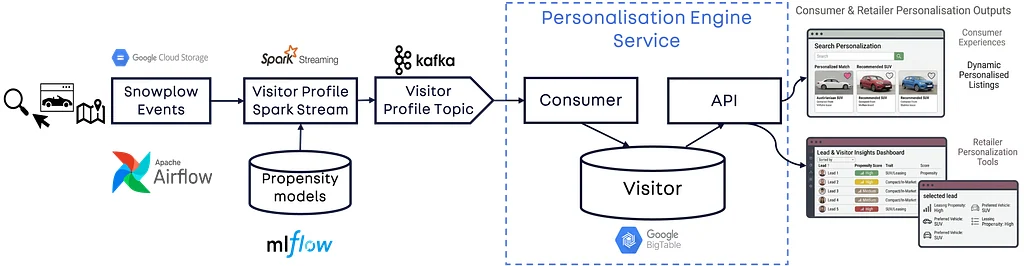
A profile that updates while you browse. "We built a Customer Data Platform (CDP)", the post says, an in-house store of what each visitor does. Every advert view, search and enquiry fires an event to Snowplow, a behavioural data platform. Events flow through Google Pub/Sub and Kafka to a Java service that updates each customer's profile in Bigtable, at about 1,000 events per second. Events carry a unique user ID only "if the customer has consented to tracking".
A rule, not a model. The profile update "takes the last 10 days of events and calculates attributes and segments". The team chose segments for fuel type and body type, because "there's no value in applying a filter a customer has already applied", so the useful segments are the filters people rarely set. For electric cars, "the most predictive feature is simply whether they've viewed EVs in the past". So the model is a proportion: the share of viewed cars that were electric, with a 50% threshold. Three electric views out of five puts a shopper in the ELECTRIC segment. Three electric and three petrol does not.
Plugged into search through a header. When a shopper opens a search page, Auto Trader's gateway fetches their profile and passes the segments along in a request header. The listing service then changes the query that picks the Featured advert: a shopper in the SUV segment gets an SUV. A segment applies only when the shopper has not set that filter, "since we only want to use segments if we don't explicitly know a customer's preference".
What it delivered
Auto Trader ran an A/B test. Customers were randomly assigned to a test or control bucket, and the control saw the Featured slot "with no customisation". The analysis covered customers who were in a segment. The result, in mean advert views per session: "For body type, we saw an average uplift between +4.8% and +7.2%, and for fuel type an average uplift between +2.1% and +4.1%", reported at a 90% confidence interval.
The team also monitored how good the segments were. "Around 1.5% of customers are in the ELECTRIC segment". Of the cars they view, "roughly 70%" are electric, and they account for "almost 50% of all electric vehicle views".
Read the numbers for what they are. The metric is engagement, not enquiries or sales. It covers one slot. The post gives no sample sizes or test length. But it is a randomised test of a simple change, which is exactly how a first step should be judged.
What has changed since
From rules to daily models. In August 2026, Richard Wilmer described the next stage on the company's engineering blog, Real-time Personalisation on Autotrader. The company, now styled Autotrader, "first built an in-house customer data platform in 2021", and its segments "were rule-based". It has moved "towards ML models that consider more data points, written in Python, and deployed in real-time using Spark Structured Streaming". The models are "retrained daily". A profile service handles "around 3,000 profile updates per second" and "around 2,000 profile read requests per second", and it "powers products such as search personalisation and buying signals". The scale behind it: "Every day, 1 million visitors generate 7 million ad views and submit 6,600 leads on Autotrader."
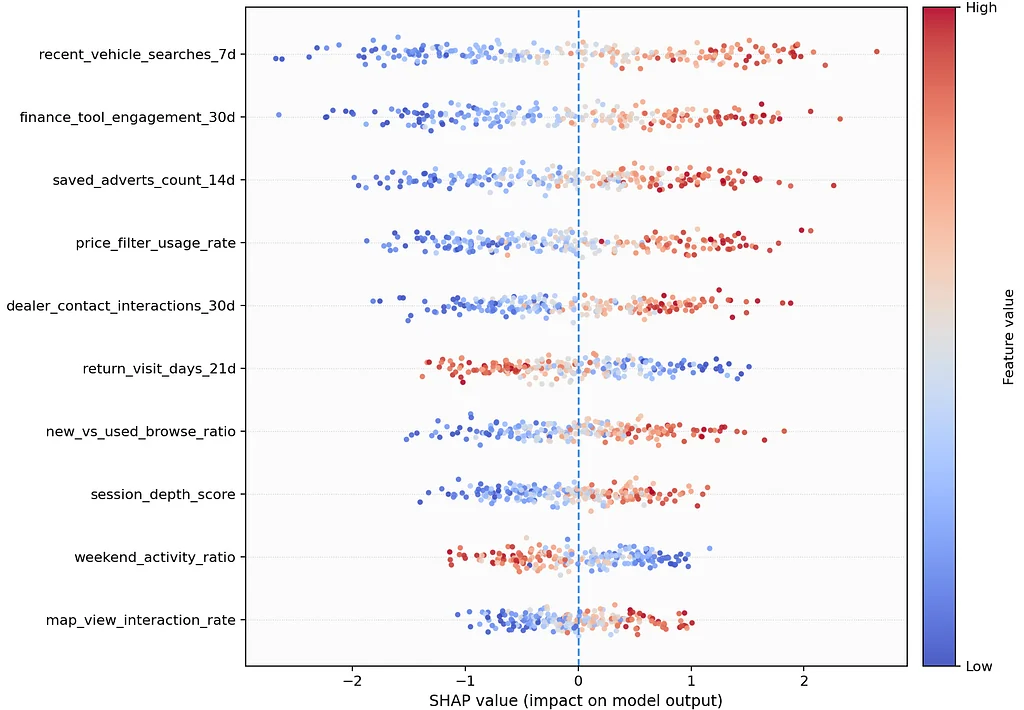
The same profiles now serve dealers. In its results for the year to March 2026, Autotrader says machine learning powers "pricing, demand forecasting and personalised consumer experiences", across "more than 50 proprietary AI and machine learning models". Its Buying Signals product, launched in January 2026, flags high-intent buyers to dealers, and the company says early results show those leads "convert at twice the average rate". The same report lists a ChatGPT app built on the Model Context Protocol, while noting that "less than 1% of audience comes from generative AI chat assistants".
Why it matters for your business
Indonesia's car marketplaces are scaling up with serious backing. In May 2025, Toyota Motor Asia took 40% of Astra Digital Mobil, the Astra unit behind OLX.co.id, which Astra says has "more than 8.5 million active users per month", and the OLXmobbi used-car business. In June 2026, Carsome Indonesia opened four more locations around Jakarta, reaching 10 service points. As stock and traffic grow, a generic results page leaves money on the table.
The 2022 recipe fits a dealer group, a regional marketplace or a property portal: track views, keep ten days of behaviour per visitor, apply one rule to one slot and test it. None of that needs a data science team. The 2026 lesson is the second payoff: once you know what a visitor is browsing, you can tell the sales team which enquiries are hot.
Behaviour linked to a person is personal data under Indonesia's personal data protection law (UU No. 27 of 2022). Consent is not the only legal basis it allows: Article 20 also lists legitimate interests, weighed against the person's rights. Article 10 gives people the right to object to decisions based only on automated processing, including profiling, that have legal or significant effects. Choosing which car to show first is unlikely to meet that bar, while scoring buyers for a sales team needs more care. We are engineers, not lawyers.
How we would build it today
- Track a few events well. Listing views with make, model, body, fuel, price band and city; searches; enquiries, including taps on the WhatsApp button. Respect the consent choice on your site.
- Keep a short rolling profile. Ten to thirty days of events per visitor in a fast store. At most Indonesian dealers' traffic, an ordinary database is enough.
- Start with one rule on one slot. The first card, or a "recommended for you" row, filled by a proportion rule like Auto Trader's.
- Test against enquiries, not just views. A random split, a metric chosen in advance, and enough time for the interval to settle.
- Move to models when rules stall. Propensity models retrained daily, as Autotrader does now, once you have the traffic and a test that shows the rules have peaked.
- Give dealers the signal. Use the same profile to flag high-intent enquiries, with the reason shown, so sales calls the right people first.
- Let shoppers stay in charge. Explicit filters always win, as they did at Auto Trader, and the privacy notice says that results are personalised.
Auto Trader's best decision in 2022 was the smallest one: one slot, one rule, one test. The models came four years later, built on a profile and a testing habit that already worked.