How Trivago gives unknown hotels a fair first look
A ranking that only trusts past clicks never learns about the hotels it does not show. In 2022 Trivago described how it adds a measured dose of optimism for little-known hotels, and what that cost.
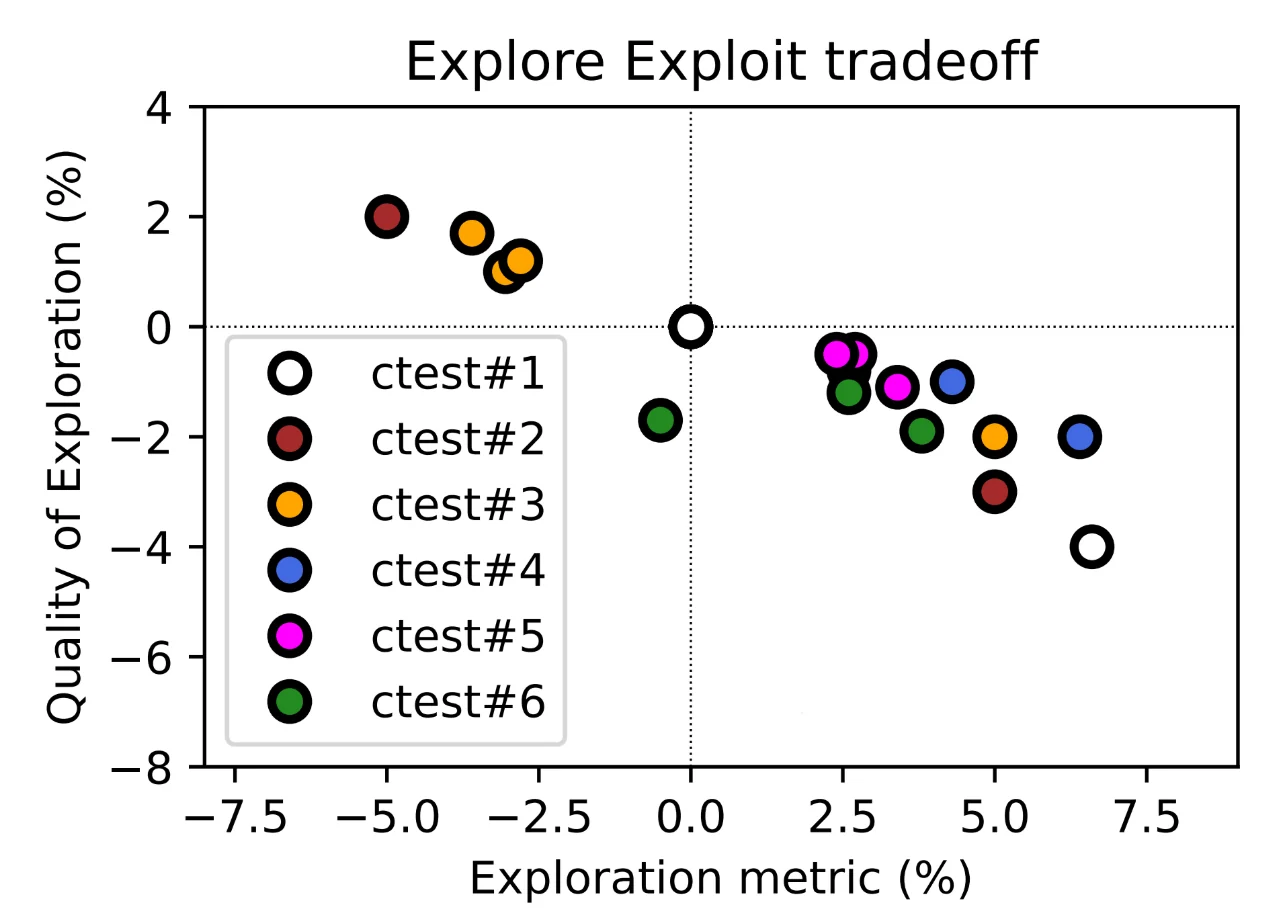
A search on Trivago can match thousands of places to stay, and the page has room for 25. In November 2022, Trivago data scientist Aida Orujova put the dilemma plainly: out of all those matches, "you have to select the “best” 25 to show to the user." Do you show the hotels you know perform well, or ones that have never been shown? Her post on Trivago's tech blog describes how the team answered with one tunable term in its ranking model, and what two quarters of A/B tests showed. Every marketplace has this problem; few describe it this clearly.
The problem: the hotels nobody sees stay unknown
A ranking learns from clicks, and clicks only happen on what is shown. Trivago calls it the cold start problem: "the number of accommodations that users never see is much larger than those seen by the user at any given time". A ranking that only trusts history keeps promoting the same hotels, and the rest never collect the data that could promote them.
Three parties lose. Users miss better options. Advertisers, the booking sites and hotels that pay Trivago per click, "rely on conversion data to optimize their bids", and new inventory has none. And Trivago, "an agent between our users and our advertisers", needs a healthy marketplace.
So the team set three measures for any way of exploring: its extent (how much click share moves to accommodations not shown before), its cost (top-line user and revenue metrics) and its quality (how well the newly shown inventory performs). The goal was a dial: an algorithm "where the extent of exploration can be controlled".
How they built it
One feature carries the history. Trivago's ranking model has a feature built from each accommodation's performance "over the course of a fixed set of days", modelled as a beta-binomial distribution. The model used the mean of that distribution. The post's verdict: "it is too greedy, purely exploiting well-performing accommodations in the model."
Step 1: optimism scaled by doubt. Instead of the mean, use "the mean plus a fraction of the standard deviation(σ) of the posterior". The less you know about a hotel, the wider its distribution and the bigger its bonus. A parameter λ sets "the strength of exploration":
score = μ + λ · σ
A worked example, ours rather than Trivago's (the post does not state its prior, so we assume a flat one). Two hotels both convert 2% of impressions. Hotel A has 2 clicks from 100 impressions; hotel B has 200 from 10,000. With λ = 1, A scores about 4.6% and B about 2.15%, so the little-known hotel ranks more than twice as high. As A collects impressions, its σ shrinks and the bonus fades on its own. The prior matters too: a flat prior treats a never-shown hotel as a 50% converter, far too generous, so start it at the average of similar hotels.
Step 2: optimism where it is likely to pay. The naive bonus "only depends on the number of impressions and clicks", so it cannot tell apart hotels with the same exposure. And "there is a very large number of accommodations that are never impressed, and it would not be efficient to cycle through them randomly." So Trivago trains a model on "high-impression inventory" to predict performance from an accommodation's features, then applies it "on low impression inventory to find suitable candidates for future exposure". The bonus becomes:
score = μ + (λ · f(item features)) · σ
The post does not name the model, the features or the prior. It does say the mechanism went "up and running in production", with dashboards that track exploration over time.
What it delivered
Over two quarters the team "ran several A/B tests", six of them on the chart above, each at several levels of exploration. In Trivago's words, "more exploration (dot on the right) led to a drop in quality". Reading the chart ourselves, every variant that explored more than the baseline sits below zero on quality. The ideal, the post says, is the upper right: lots of exploration and good performance from what gets explored.
Trivago reports three learnings:
- it exposed a higher share of "high quality unexplored inventory at no short term revenue cost", which it calls "the “golden mean”";
- "There was no significant shift in advertiser clickshares due to the exploration mechanism", so exploring did not tilt clicks toward a particular advertiser;
- λ "acts as a good parameter for controlling the extent of exploration".
Read it with care. The post gives no figures in the text, does not define the quality metric, shows no error bars and does not name the variant it shipped. It also admits that "some models had negative exploration or had worse quality compared to the naive approach". These are Trivago's own results.
What has changed since
Trivago built tools to test faster. A 2023 post explains why: A/B tests need "millions of user visits, which can span several weeks to accumulate". Its replay simulator screens ideas faster, but "the tool doesn’t simulate user click behavior", so exploration still needs a live test. We found no later Trivago post on exploration, so we cannot say whether this mechanism still runs.
Airbnb had reached the same fork. In a 2020 paper, Airbnb described tuning a new-listing boost "to be bookings neutral compared to no boosting, while allocating +8.5% additional first page impressions to new listings". It found the explore-exploit framing hard to operate and "reframed it as a problem of estimating the engagement values for a new listing". That is the direction of Trivago's step 2: predict from features rather than explore blindly.
The bonus keeps getting refined. A 2025 paper tailors the same kind of bonus "to auction pay-per-click systems", the market Trivago runs. A 2026 paper warns that a flat prior means "implicitly assuming a 50% success rate for unseen items", the trap in our worked example.
Why it matters for your business
Any business with a "top results" list has this problem: a property portal, a car marketplace, a clinic directory, an online shop. Rank only by past clicks or sales, and newcomers never get seen, so you never learn which of them are good.
For a villa or boutique hotel owner in Indonesia, the lesson runs the other way. You do not control how an OTA ranks you, and the big local platforms do not publish how search order treats new listings. Traveloka's partner page says it "does not entail additional fee to property owners" who register, but says nothing about ranking. What you do control is what a model like Trivago's f(item features) reads: complete and accurate listing data, good photos, a sensible first price and early reviews. Airbnb's own tool for new listings is a price lever, not a ranking boost: "a 20% discount to any eligible listings for the next three bookings", for listings with "fewer than 3 bookings". Airbnb reports that 2025 listings which used it saw "more than 70% more bookings" in their first three months. Hosts chose to opt in, so read that as a correlation.
In 2026 there is a gate before ranking, too. Indonesia now requires accommodation to hold valid operating licences and business classifications, with a deadline of 31 March 2026, and TTG Asia reported "more than 29,000 non-hotel accommodation units listed on OTA platforms in Bali, while only around 14,500 were recorded in the national business registry." A new villa without its registration may not get a ranking at all.
Exploring on counts per listing (impressions and clicks) needs no personal data. Once you personalise rankings for each user, Indonesia's personal data protection law (UU No. 27 of 2022) applies to the behaviour you use.
How we would build it today
- Count first. Log impressions and clicks (or bookings) per item over a fixed window.
- Give every item a posterior with a sensible prior. Start new items at the average of similar items (same area, type and price band), not at 50%.
- Rank with a bonus that fades. Use μ + λσ, or Thompson sampling (draw a score from each item's posterior). Both shrink the bonus as data arrives. Keep λ in config.
- Cap the experiment. Open a small, fixed share of first-page slots to exploration, and widen it only if the numbers allow.
- Aim the bonus with a feature model once you have enough well-known items: train on them, predict from attributes, as in Trivago's step 2.
- Measure extent, cost and quality per test, plotted together, so you choose a trade-off on purpose.
- Simulate to screen, A/B test to decide. Replays are fine for catching bugs; only live traffic shows what exploration does to clicks.
The lasting lesson from Trivago: a ranking is also a way of collecting data. If you only show what you already know works, you will only ever learn about what you already show.