How Zillow learned to spot serious home buyers, and what changed by 2026
Most people browsing homes online are not buying anytime soon. Zillow built a model to find the ones who are, with a clever answer to a problem every sales team has: nobody tells you who actually bought.

Zillow is the biggest home-search site in the United States. In 2022 it had tens of millions of visitors a month, and they were not all shopping. Some were renters. Some checked what their own house was worth. Many were just dreaming. A small group were about to buy.
Telling those groups apart matters. A serious buyer should be offered a local agent. A dreamer should get more homes to browse and no sales pitch. In November 2022 Zillow's data science team described how they built a model for this in Identifying High-Intent Buyers. The approach carries over well beyond real estate: car dealers, developers, insurers and anyone else with more leads than salespeople.
The hard part was the label, not the model
To train a model that predicts "will buy soon", you need examples of people who did buy. Zillow had no such list. People close their purchase with a bank and an agent, not on the website.
Their answer was public records. In the US a home sale becomes a public record within about 60 days of closing. Zillow matched those records to registered accounts, so a user who browsed in spring and appears as a buyer in summer becomes a positive example.
The team was open about the flaw: many real buyers never match, so they are counted as negatives. The labels are incomplete and noisy, and the model is trained anyway. That is the first lesson. You rarely get clean ground truth. Use whatever record the world already keeps of the outcome you care about, and design the rest around its gaps.
What the model looked at
They started with more than 1,500 behaviour signals in three groups:
- On the site: how many home listings a person viewed, session length, time spent on a listing, saves and shares, visits to agent profiles, each measured over 1, 3, 7, 28 and 56 days, on web and mobile.
- Off the site: opens and clicks on emails and push notifications, by campaign.
- Preferences: the locations and home types a person looks at, and how that search narrows over time. Someone who stops browsing three cities and starts comparing two streets is telling you something.
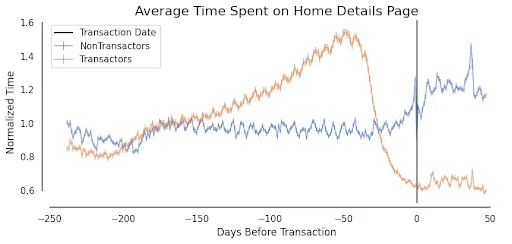
They cut this down to 50 features, partly to make the model easier to debug and partly for fair-housing review. In housing, as in lending and insurance, you need to be able to explain why the system treats people differently.
The model itself was ordinary on purpose: gradient-boosted decision trees, more than 1,000 of them, trained with the non-buyers downsampled because buyers are rare. Every registered user was scored daily.
Measuring when your labels are wrong
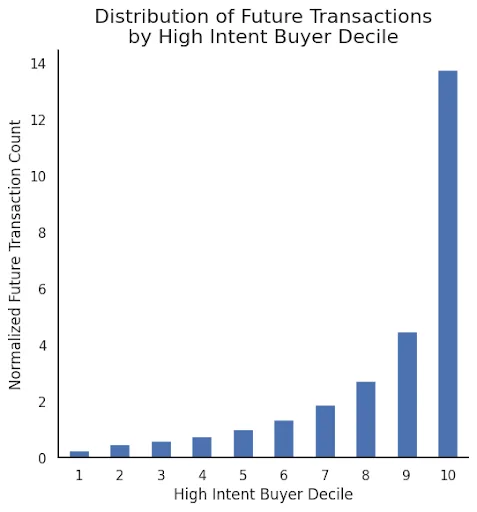
Because so many true buyers are labelled as non-buyers, the usual accuracy metrics were misleading. Zillow measured lift instead. They split users into ten equal groups by score and compared how often each group turned out to be a matched buyer.
The top 10% were 52 times more likely to be buyers than the bottom 10%, 10 times more likely than the middle group and 3 times more likely than the second-best group. A sales director understands that without a statistics lecture: call the top group first.
What Zillow does now
From trees to "behaviour as language"
In April 2026 Zillow described its next step: a transformer model that reads a person's home search as a sequence of events, the way a language model reads words (Learning the language of home buying). It was trained on search journeys that started more than 60 days before a confirmed purchase, the same idea of learning from real transactions as in 2022.
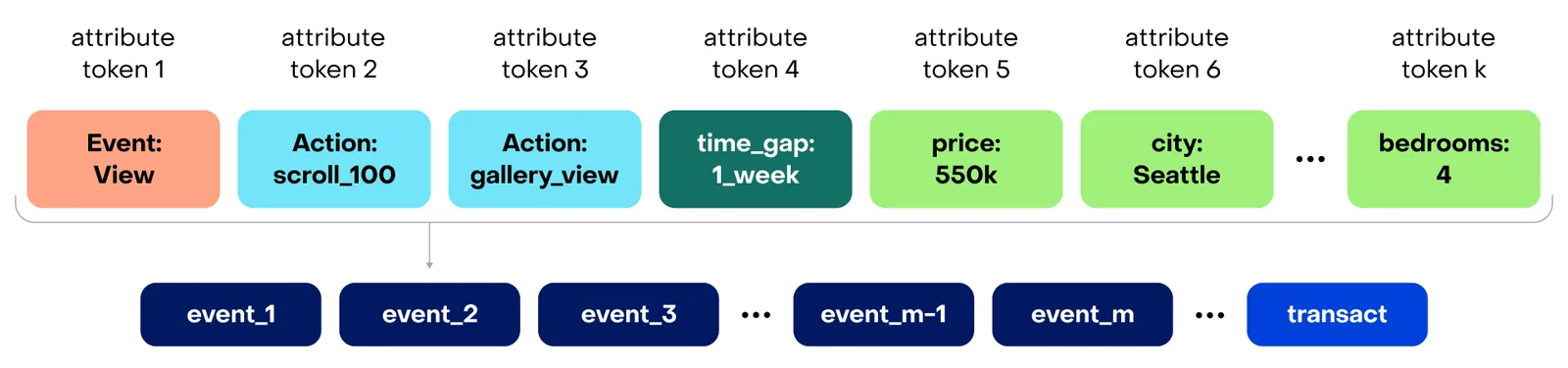
Two details stand out. Engineering work cut the model's response time from about 8 seconds to around 300 milliseconds, and caching cut the compute for some predictions by more than 80%. And Zillow tried off-the-shelf LLMs and rejected them because they invented listings and prices. They built a model on their own behaviour data instead. Zillow also says the model is not used for housing eligibility or lending decisions.
First-party data became the asset
In February 2026 Zillow described its AI strategy around roughly 230 million average monthly users and the behaviour signals they generate. Outside Zillow, Google dropped its plan to remove third-party cookies from Chrome in July 2024, but Safari and Firefox already block them by default, so tracking people across other sites stays unreliable. What people do on your own channels is the signal you can count on.
The business around leads changed
In the US, the 2024 National Association of Realtors settlement changed how buyer agents are paid. Since August 2024 buyers must sign an agreement with an agent before touring homes. Knowing which buyers are serious did not become less valuable, but who pays for that knowledge, and when, shifted.
Why it matters for your business
You do not need Zillow's traffic to use this. Most companies in Indonesia that sell homes, cars or insurance already have what the model needs:
- Signals: website visits, brochure downloads, virtual tour time, WhatsApp chats, showroom or site visits, test drives.
- Labels: your CRM knows who actually signed. That is your version of Zillow's public records, and probably cleaner.
- A use for the score: a sales team with limited hours. Route the top group to your best salespeople the same day. Keep the rest warm with useful content instead of calls.
Three lessons carry over directly. Start with a simple model you can explain, because your sales team will only trust a score they understand. Measure lift by group instead of a single accuracy number. And collect behaviour data with consent: Indonesia's Personal Data Protection Law (UU PDP) has been fully in force since October 2024.
How we would build it today
We would connect the channels a buyer actually uses (website, virtual tour, WhatsApp, CRM), use closed deals as labels, and start with a gradient-boosted model on a few dozen signals, retrained weekly. The sales team would get a simple dashboard: this week's top leads and the lift of each group. We would use a language model to turn chat conversations into structured signals, such as budget, timeline or a request for a site visit, and not as the scorer itself, for the same reason Zillow gave: a scorer that makes things up is worse than no scorer. Sequence models come later, once there is enough volume to justify them.